WORKS

Creativity, reflection, and elegance in aesthetic sensibility. In these works, genius manifests itself not as excess or virtuosity, but as the ability to subtract. It is a formal intelligence born of restraint, control, and a profound understanding of visual codes. Nothing is random: every chromatic, compositional, and symbolic choice responds to a rigorous internal logic, often invisible but always perceptible. Harmonious tensions between fullness and emptiness, between geometric rigor and human presence.

The face becomes landscape, architecture becomes gaze. In glasses, the world is not reflected: it is reinvented. The body dialogues with immobile, almost metaphysical geometries. Blue cools the skin, while gold ignites desire and artifice. Lipstick doesn't complete the face: it transforms it into an icon. Fashion and architecture speak the same language of desire here. Luxury ceases to be an object and becomes a form of gaze. Everything appears perfect, smooth, distant, almost unreal. It's a world suspended between advertising, dream, and contemporary solitude. Perhaps we don't see what exists, but what we desire to see.


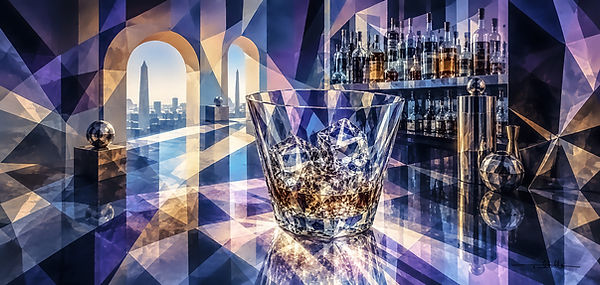
The glass is not merely a container, but a design object: conceived, designed and constructed through proportion, material and transparency. Within it, the ice and liquids — amber, cognac and whisky — become visual elements that capture and transform light, producing ever-changing reflections, geometries and colours. Placing this object within a metaphysical space means taking it beyond its everyday function and transforming it into a threshold. The cocktail thus represents an entrance into a dimension different from the conventional one: not simply the effect of alcohol, but a distinct perceptual and cultural state in which greater attention is directed towards aesthetics, light, colour, form and the transformations of reality.
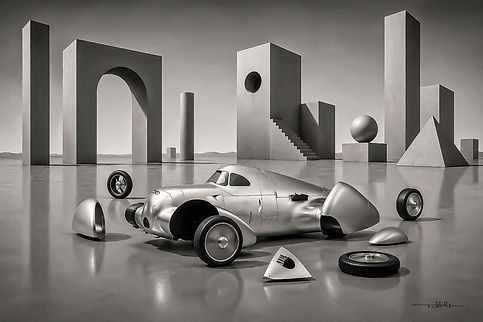

The machine advances motionless, like a memory of the future. All around, the architecture has lost all function and has become thought. The wheels separate from the body, like possibilities that refuse a single direction. There is no road, because the journey no longer needs a destination. Speed is suspended, held in the instant before departure. Man is absent, but every form seems to retain the memory of his passage. Technology, stripped of its utility, becomes pure metaphysics. Black and white erases time and confuses past and future. A machine remains faced with the enigma of space. And perhaps every journey is merely an attempt to distance ourselves from what we are.

"Hi Marco, we just discovered your profile and wanted to tell you how impressed we were by the images. Not just for their graphic beauty, but for the coherence with which color, geometry, and shapes create a recognizable little world each time. It's rare to find a page with such a clear visual identity. Congratulations, truly."
— Department of Colorimetry


It is an elegance that comes from moderation, not from ostentation. The dusty colours, light blue and ivory, create a silent, almost domestic luxury. The female figure is composed, symmetrical, impeccable, but the face disappears: identity leaves room for form. The lampshade becomes both hat, architecture and mask, transforming the absurd into something surprisingly refined. Nothing seeks to seduce openly, and for this very reason everything has a subtle sensuality. The metaphysical geometries on the sides seem to guard a scene out of time. Bourgeois furnishings are taken away from normality and brought into the dimension of dreams. It is a polite, almost aristocratic elegance, however crossed by a slight surrealist irony. It is not the beauty of those who want to be looked at, but of those who can afford to remain indecipherable. And perhaps the real luxury is precisely this: not having to explain yourself.


The airport is perhaps one of the most existential places we've ever created. It truly belongs to no one: it's a suspended space, where for a few hours we cease to be who we were without yet being who we will be. Leaving means escaping the present, trusting in the possibility that something exists elsewhere capable of changing us. Returning, on the other hand, means measuring the distance between those who left and those who return. Every journey thus contains a small separation from ourselves. The airport becomes a place of waiting and possibility: the point where life, before resuming a direction, remains suspended for a moment, faced with all the other directions it could have taken.

For Dalí, the lobster was not merely a marine animal; it was, above all, an erotic, uncanny, and surreal object, defined by the contrast between a hard shell and a soft, vulnerable interior. The most famous example is the *Lobster Telephone* (1936), in which the handset is replaced by a lobster. Dalí explicitly linked the lobster to sexuality and desire; the animal’s placement on the phone deliberately heightens the erotic undertones. The Surrealist concept lies precisely in combining two perfectly recognizable yet incompatible objects—a telephone and a crustacean—to create something that seems to emerge from a dream. The lobster reappears in the famous *Lobster Dress* created with Elsa Schiaparelli in 1937: a large lobster painted by Dalí adorns the front of the gown, positioned in a way that is deliberately charged with sexual allusion. Yet there is a second aspect—particularly relevant to my "lobster in a glass"—that I find fascinating: the hard-versus-soft contradiction. Dalí was obsessed with the transformation of matter—rigid things turning soft, bodies becoming distorted, objects losing their normal function. The lobster is almost perfect for this vocabulary: an external shell with tender flesh inside; visual aggression paired with biological fragility; a form that is almost monstrous yet incredibly elegant.
And there is an interesting distinction to be made regarding Lanthimos’s film *The Lobster*, which we were discussing: the symbolism differs. In the film, the lobster chosen by the protagonist primarily evokes longevity, the capacity for continued growth, fertility, and life in the sea. In Dalí’s work, it is far more closely tied to Eros, the unconscious, desire, and a sense of estrangement. Thus, when placed inside my transparent glass, the lobster can take on a distinctly Dalí-esque significance: something living and carnal imprisoned within an elegant, transparent, geometric structure. The glass distorts what we see, while the lobster retains its recognizable form. It is precisely that boundary between reality and perceptual alteration that renders the image surrealist.

